EEI MASS Assembling Objects
How to solve EEI MASS Assembling Objects problems, labeled parts and unlabeled puzzle pieces, with a step-by-step method and four worked, drawn examples.
Practicing for the EEI MASS? Take the free practice test: 12 questions, no account needed.
Assembling Objects is the MASS test most people have never seen. EEI's brochure says it measures your ability to visualize the correctly assembled form of an object, with 20 multiple-choice questions and a 15-minute limit. That's 45 seconds a question.
There's nothing to memorize. It's a skill, and it responds well to a method and to short, regular practice.
The two kinds of problem
The brochure describes two types:
- Labeled parts. The parts carry letters, and you assemble them by matching the letters.
- Unlabeled parts. You treat the parts like pieces of a puzzle and choose which of four choices shows them assembled correctly.
In our practice tests, the parts are drawn in a box at the top, and the four choices, A to D, are in boxes below. In both kinds, the parts may be turned but never flipped over. A flipped part is a mirror image, which is a different part. Follow the directions on your real test.
Labeled parts: a method
- Read the letters. Note which letter sits on which part, and where: on a corner, or halfway along a side. "Halfway along the longest side" is a place you can find again.
- Take one part at a time. In each choice, find that part and check where the line touches it. Both ends of every line must be at the right places.
- Look for a flip. A part that looks like a mirror image has been flipped. Use a feature that tells left from right, such as the corner at the end of the longest side, and check which way you go from it to the dot.
- Eliminate. A choice that's wrong in one place is out. Stop when one choice is left.
Worked example: two parts
The top box shows two five-sided parts and a short line, with Z at one end of it and W at the other. On the left part, Z is halfway along a side. On the right part, W is on a corner, just above the end of that part's one long edge.
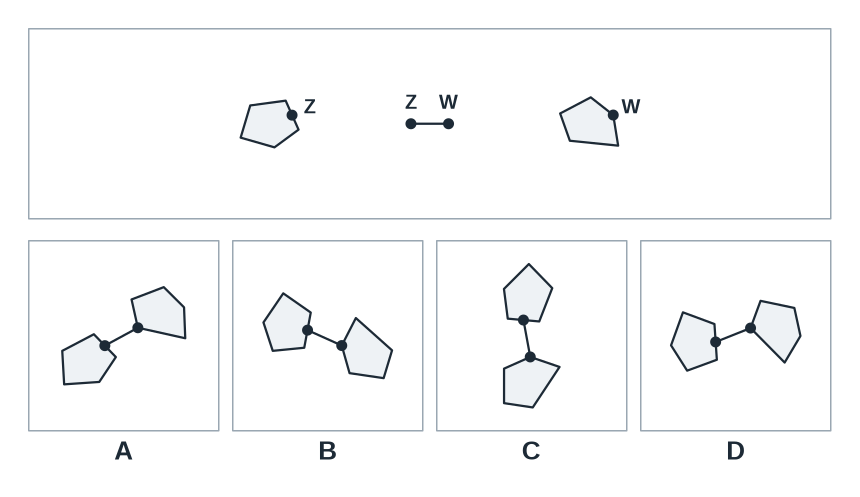
Take the Z part first: the line must end halfway along a side of it. Then check the W part: the line must end on that corner. The answer is C.
- A puts the W end of the line at a different corner of the right part.
- B puts the Z end on a different side of the left part, the one next to it.
- D makes both of those mistakes.
A and B each look fine from a distance. Each is wrong on only one part, so you only find the fault by checking both parts.
Worked example: three parts
Harder problems have three parts and two lines. Here, one line joins E to R, and the other joins Q to U. The middle part carries both R and Q, all on corners.
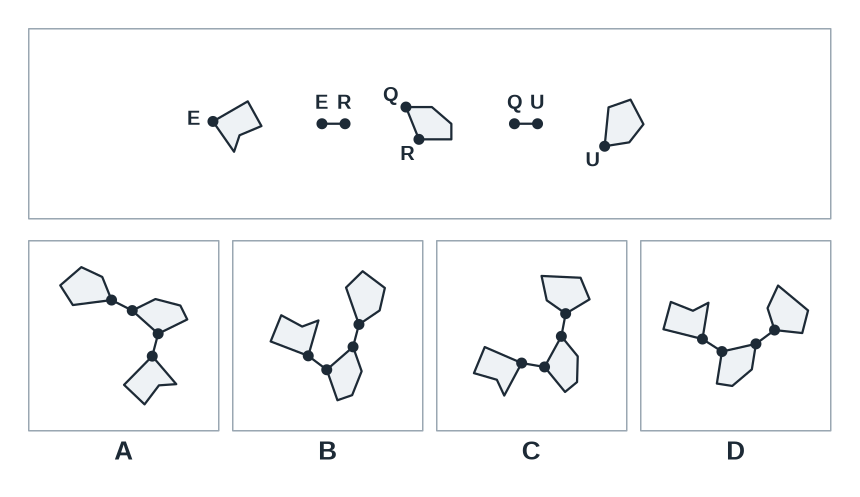
Start with the middle part, because its two dots fix how the lines sit. R and Q are at the two ends of that part's longest side, so in the right figure the two lines meet it there.
The answer is B.
- A shows the left part, the one with E, flipped over.
- D puts U at a different corner of the right part.
- C makes both of those mistakes.
Unlabeled parts: a method
With no letters, you have to compare shapes. The test is whether each choice is made of exactly the pieces given.
- Do a size check. The pieces together fill the assembled shape. A choice that looks clearly larger or smaller than the pieces can fill is out.
- Pick the most distinctive piece. The one with the sharpest corner, the most sides or the longest edge is easiest to find. Turn it in your head until one edge matches, and look for it in each choice.
- Skip a piece that's the same in every choice. It can't tell them apart.
- Check that every piece matches. The right choice has all of them. Each wrong choice has a piece that's too big, too small or the wrong shape.
Worked example: three pieces
The top box shows three pieces: one four-sided, and two five-sided.
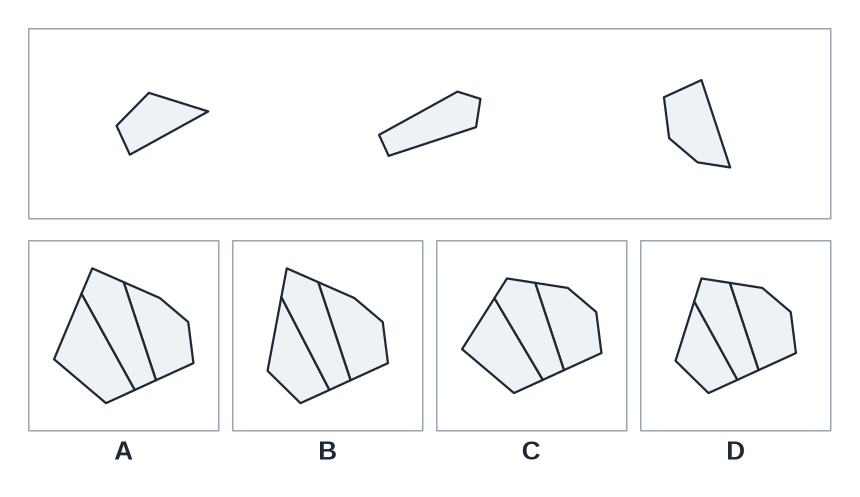
The size check helps first. The three pieces fill about the same area as D, and A is clearly bigger, so A is out. Then check pieces. In A and C, the four-sided piece on the left is bigger than the one you were given. In B, each piece is a little larger than its match. Only D is made of all three pieces. The answer is D.
Worked example: four pieces
The top box shows four pieces: a triangle, and four-, five- and six-sided pieces. The six-sided one is long and thin.
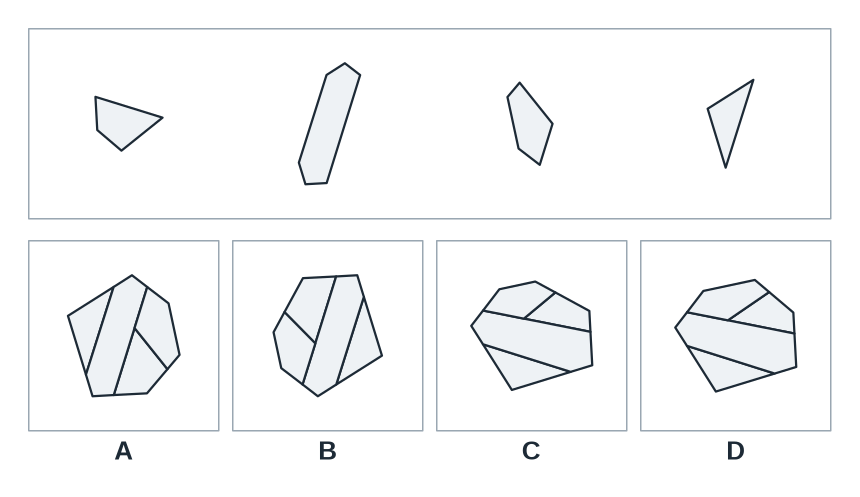
The triangle is the same in all four choices, so skip it. Look at the long six-sided piece instead. In C and D it's noticeably fatter than the one you were given, so both are out. B has a five-sided piece that's smaller than the given one. That leaves A, and its four pieces all match. The answer is A.
Pace and practice
- Budget about 45 seconds a question, and less on a problem you see quickly. Time saved on easy ones pays for the hard ones.
- Never leave a blank. EEI's brochure says there's no penalty for wrong answers. If you've ruled out two choices, you're guessing between two.
- Don't trust a first glance. In our practice, a wrong choice usually differs from the right one by a single change.
- Practice a little each day. Ten minutes on each kind of problem builds the skill faster than one long session.
Duke Energy's employment tests page lists EEI practice tests for the MASS; use the practice login your employer gives you. The free EEI MASS practice test has three Assembling Objects questions, and each of our 20 full EEI MASS practice tests has 20 timed ones with both kinds of problem, each explained. For the whole test, see how to prepare for the EEI MASS.
Watch the video lessons
- MASS Assembling Objects Puzzle: Unlabeled Pieces Explained on ExamVanta's YouTube channel
- MASS Assembling Objects: Labeled Parts, Step by Step on ExamVanta's YouTube channel
Free to share: you may copy and share this guide unchanged, for non-commercial purposes such as teaching and study, if you credit ExamVanta and link to this page. It's licensed under CC BY-NC-ND 4.0. Material from other sources quoted or shown in it, such as official text or chart excerpts, keeps its own terms.
More EEI MASS guides
- How to Prepare for the EEI MASS Test: A Study Plan
A three-week plan for the EEI MASS: check your battery, learn what each test asks, practice Assembling Objects, use timed tests and review mistakes.
- EEI MASS Mathematical Usage: Tips and Practice
How to work the 18-question, 7-minute EEI MASS Mathematical Usage test: using the information at the start, converting units and when to choose N, with examples.
- EEI MASS Mechanical Concepts: Principles and Practice
The principles behind EEI MASS Mechanical Concepts questions, from gears, levers and wrenches to pulleys, slings, hydraulics, heat and circuits, with worked examples.
- EEI MASS Passing Score, Index Score and Test Day
How the EEI MASS index score works, why no pass mark is published, how long the test takes, calculator rules, retake waits and what to bring on test day.
- EEI MASS Reading Comprehension: Tips and Practice
How to answer EEI MASS Reading Comprehension questions: reading plant training material and answering from the passage alone, with a worked example and common traps.