EEI CAST Graphic Arithmetic
How EEI CAST Graphic Arithmetic questions work: reading dimensioned drawings, finding lengths, areas and volumes, and the traps to avoid, with worked examples.
Practicing for the EEI CAST? Take the free practice test: 12 questions, no account needed.
Graphic Arithmetic is the EEI CAST section that tests reading a technical drawing and working out lengths, areas and volumes. Crews and skilled trades do this kind of reading every day, from a plate drilled for bolts to the plan of a trench. The arithmetic is simple. The difficulty is choosing the right numbers from the drawing, quickly.
How the questions are set up
Each drawing comes with a group of questions. The drawing shows dimensions such as overall sizes, offsets from an edge, spacings and depths. The questions ask for something the drawing doesn't print directly, so you combine what's given.
In our practice tests, Graphic Arithmetic has 16 questions in 30 minutes, about 1 minute 50 seconds each. Each question has four numeric answers plus None of these. That option is sometimes correct, so never pick the closest number just because it's close.
These are the drawings you'll meet most often:
- a plate with drilled holes: spacing between hole centers and the solid metal between holes;
- a route or duct run with right-angle turns: total length, length between two points, and how far down or up it ends;
- a platform or room with a cut-out or extension: total area, remaining area and perimeter;
- a trench or tank shown in plan and in section: area of the floor, volume of each layer and space left to fill.
Worked examples
Hole spacing
A plate is 40 in wide. Hole A's center is 8 in from the left edge; hole B's center is 10 in from the right edge. Both holes are 4 in in diameter.
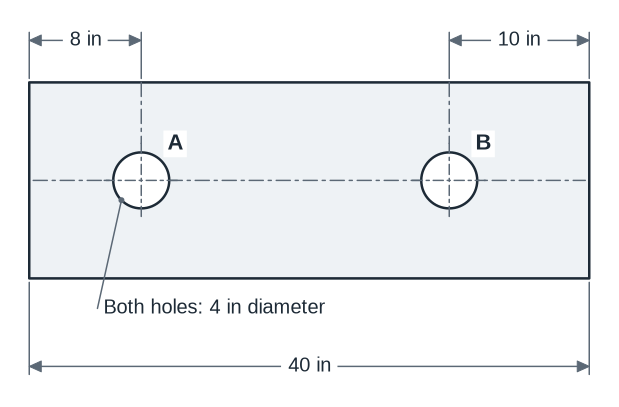
- Center to center: 40 − 8 − 10 = 22 in.
- Solid metal between the hole edges: take a radius (2 in) off each side, so 22 − 2 − 2 = 18 in.
The trap is answering 22 when the question asks for the metal between the holes, or the other way round.
Equally spaced holes
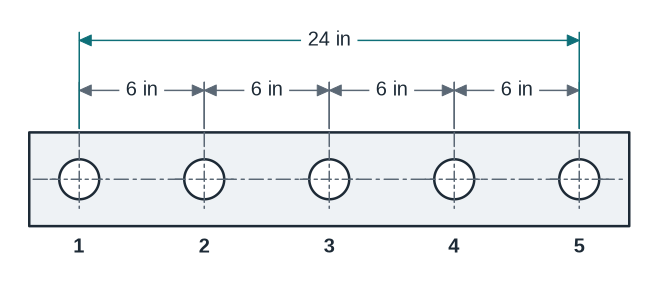
Five bolt holes sit in a row, each center 6 in from the next. How far is it from the first center to the last?
There are only four gaps between five holes, so 4 × 6 = 24 in, not 30 in. Count the gaps, not the holes.
Area with a cut-out
A platform is 30 ft by 16 ft, with a 6 ft by 4 ft notch cut from one corner.
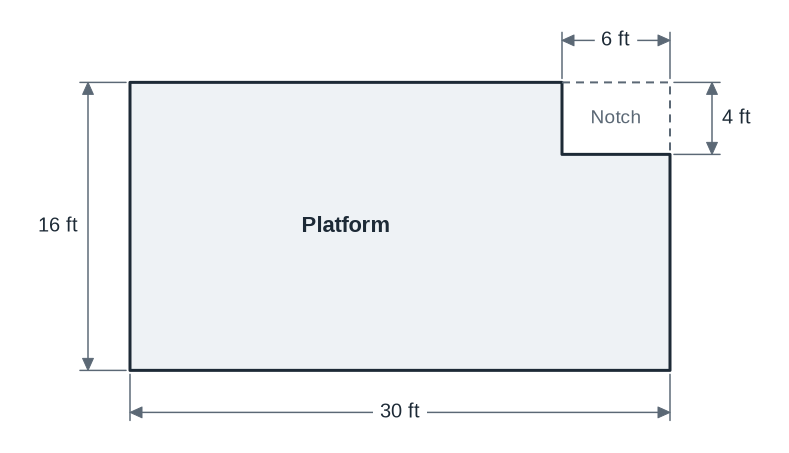
- Remaining area: 30 × 16 = 480 ft², minus 6 × 4 = 24 ft², gives 456 ft².
- Perimeter: a notch cut from a corner doesn't change it. The two cut edges replace the two missing edges exactly, so it's still 2 × (30 + 16) = 92 ft.
Volume of a layer
A trench is 20 ft long and 5 ft wide. Its bottom layer of gravel is 1 ft thick, and the trench is 4 ft deep in all.
- Gravel: 20 × 5 × 1 = 100 ft³.
- Whole trench: 20 × 5 × 4 = 400 ft³.
Check which layer the question asks about before you multiply.
Elevations and slopes
Point A is at elevation 15 ft and point B at 19 ft, 3 ft apart horizontally.
- Rise from A to B: 19 − 15 = 4 ft.
- Sloped distance: a 3-4-5 right triangle, so 5 ft.
Questions often give elevations, not rises, so subtract first.
Common traps
- Center to center versus edge to edge. Read the last few words of the question twice.
- Holes and gaps. n equally spaced items have n − 1 gaps between them.
- Removed versus remaining. "The area of the notch" and "the area after the notch is removed" are different answers.
- Mixed units. If a drawing is in feet and the question wants inches, convert at the end. Twelve inches to a foot, and 144 square inches to a square foot.
- Inventing a dimension. If a length isn't given, it can be worked out from the ones that are, for example a room's width from the total and the other room. You never need to measure the drawing.
How to work faster
- Write each dimension you use on your scratch paper with a label (for example "L 8, R 10, W 40"). Most mistakes come from picking up the wrong number.
- Answer the drawing's questions in order. Later questions often reuse a result from an earlier one.
- Work out your own answer before you look at the choices. If it isn't there, consider None of these before you rework the arithmetic.
Practice
The free EEI CAST practice test starts with Graphic Arithmetic questions on a platform drawing. Each of our 20 full EEI CAST practice tests has two new drawings with eight questions each, and every answer is explained step by step. For the whole test, see how to prepare for the EEI CAST.
Watch the video lesson
- EEI CAST Graphic Arithmetic Practice: 4 Solved Questions on ExamVanta's YouTube channel
Free to share: you may copy and share this guide unchanged, for non-commercial purposes such as teaching and study, if you credit ExamVanta and link to this page. It's licensed under CC BY-NC-ND 4.0. Material from other sources quoted or shown in it, such as official text or chart excerpts, keeps its own terms.
More EEI CAST guides
- How to Prepare for the EEI CAST Test: A Study Plan
A practical three-week plan for the EEI CAST: what each section asks, how to use timed practice tests, what to review and how to pace yourself.
- EEI CAST Mathematical Usage: Tips and Practice Questions
How to work EEI CAST Mathematical Usage questions fast: unit conversions, feet and inches, time, area and rates, with worked examples and the common traps.
- EEI CAST Mechanical Concepts: Principles and Practice
The principles behind EEI CAST Mechanical Concepts questions, from gears, belts, levers and pulleys to hydraulics, fluids and circuits, with worked examples.
- EEI CAST Passing Score, Scoring and Test Day
How the EEI CAST is scored, why no passing score is published, how long the session takes, calculator rules, retake waits at real utilities and what to bring.
- EEI CAST Reading for Comprehension: Tips and Practice
How to answer EEI CAST Reading for Comprehension questions quickly and accurately: reading short workplace records, applying their rules, with a worked example.
- EEI CAST-R Test: What It Is and How It Differs From the CAST
What the EEI CAST-R covers, how it differs from the original CAST, what the Work Preferences Inventory asks, and what EEI hasn't published about it.
- EEI Tests Explained: EEI CAST, POSS, MASS, TECH, SASS
Which EEI test is on your invitation? What the CAST, CAST-R, POSS, MASS, TECH, SO/PD, SASS, CSR and meter reader tests cover, and who takes each.