EEI CAST Mechanical Concepts
The principles behind EEI CAST Mechanical Concepts questions, from gears, belts, levers and pulleys to hydraulics, fluids and circuits, with worked examples.
Practicing for the EEI CAST? Take the free practice test: 12 questions, no account needed.
Mechanical Concepts is the EEI CAST section on how machines, fluids and simple circuits behave. Each question shows one mechanism and asks what happens: which way a gear turns, how much force a lever or hoist needs, what changes when a part is added or removed.
In our practice tests the section has 44 questions in 20 minutes, about 27 seconds each, and every question has three answer choices. That's too little time to work things out from first principles. The questions keep coming back to the same dozen or so ideas, so learn them until you recognize each one on sight. They're all below.
Gears
- Direction: each external mesh reverses the direction of turn. Two gears in mesh turn opposite ways. In a row of three, the first and third turn the same way.
- Idler gears: a gear between the driver and the output changes the output's direction but not its speed.
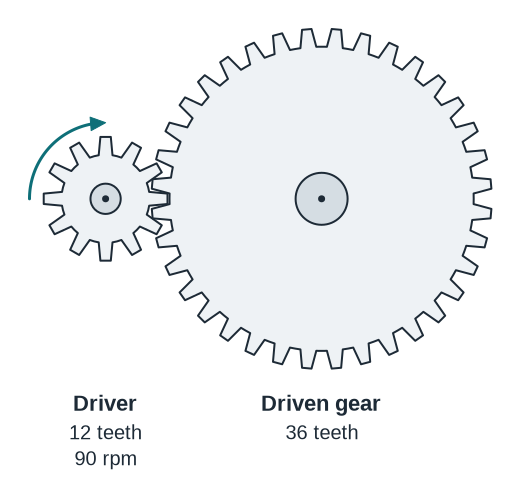
- Speed: output rpm = input rpm × driver teeth ÷ driven teeth. A small gear driving a large one turns it slower.
Example: a 12-tooth gear at 90 rpm drives a 36-tooth gear. The output turns at 90 × 12 ÷ 36 = 30 rpm, in the opposite direction.
Belts, chains and sprockets
- Open belt: both pulleys turn the same way.
- Crossed belt: the pulleys turn opposite ways.
- Speed: works like gears, using diameters for pulleys and teeth for sprockets.
- Slipping: a belt that slips, or has come off, delivers less speed or none at all.
Example: a 10 cm pulley at 120 rpm drives a 30 cm pulley with a taut belt. The follower turns at 120 × 10 ÷ 30 = 40 rpm.
Levers and wheels
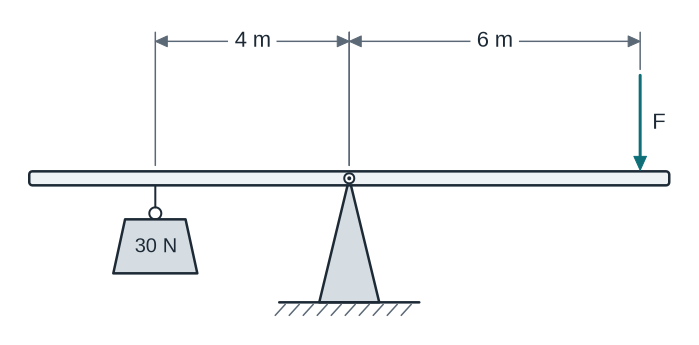
- Balance: force × distance from the pivot (the moment) must be equal on both sides.
- Longer arm, less force: the same push farther from a pivot, hinge or bolt turns harder. That's why a longer wrench or pry bar helps.
- Wheel and axle: a larger wheel gives more turning effect for the same push at its rim.
Example: 30 N hangs 4 m left of a pivot. To balance it at 6 m on the right you need 30 × 4 ÷ 6 = 20 N.
Pulleys and hoists
- Force: count the rope segments that hold up the moving block. The pull needed is the load divided by that number.
- Distance: the rope you pull is the lift multiplied by the same number.
- A single fixed pulley only changes the direction of the pull. It gives no force advantage.
Example: a 330 N load hangs on 3 supporting segments. You pull 330 ÷ 3 = 110 N, and to raise the load 2 m you pull 2 × 3 = 6 m of rope.
Hydraulics
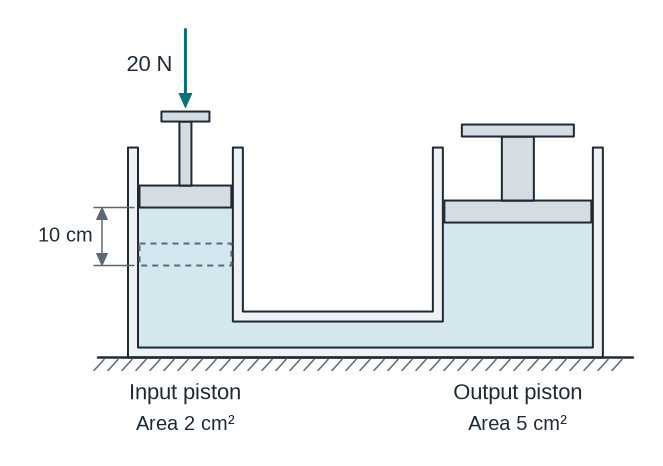
- Pressure: pressure is the same throughout a sealed liquid, so output force = input force × output area ÷ input area.
- Trade-off: what you gain in force you pay for in distance. The large piston moves less.
- Air: air in the line compresses, so the system feels soft and transmits less.
Example: 20 N pushes a 2 cm² piston connected to a 5 cm² piston. The output force is 20 × 5 ÷ 2 = 50 N. If the input moves 10 cm, the output moves 10 × 2 ÷ 5 = 4 cm.
Ramps, work and power
- Ramp force: on an ideal ramp, the push along the slope = weight × rise ÷ slope length. A longer, shallower ramp needs less force over more distance.
- Work: work = force × distance. Raising the same load to the same height takes the same work, however you lift it.
- Power: power = work ÷ time. Faster means more power, not more work.
Example: a 200 N crate goes up a 10 m ramp that rises 2 m. The ideal push is 200 × 2 ÷ 10 = 40 N. Check: 40 N × 10 m = 400 J, the same as lifting 200 N straight up 2 m.
Springs
- Stretch: force = stiffness × stretch. Double the force, double the stretch.
- In series (end to end), two identical springs stretch twice as far under the same load.
- In parallel (side by side), they stretch half as far.
Example: a spring of 12 N/cm stretched 3 cm needs 36 N.
Rolling wheels
- One full turn moves a wheel forward by its circumference. A wheel of circumference 2 m rolls 10 m in 5 turns.
- Over the same distance, a smaller wheel makes more turns.
Liquids and gases
- Depth: pressure in a still liquid depends only on depth. Two taps at the same depth have the same pressure, whatever the tank's width or shape. A deeper tap has more pressure.
- Narrow pipes: in a pipe that narrows, the same flow moves faster. At half the area, it moves at twice the speed.
- Flow in, flow out: 70 L/min in, with 20 L/min out of one branch, leaves 50 L/min for the other.
- Floating: a floating object is held up by a buoyant force equal to its weight. It floats higher in denser (salt) water.
- Sealed gas: in a rigid container, pressure rises with absolute temperature. From 250 K to 375 K is 1.5 times.
Simple circuits
- Series: in a single loop, one open lamp or switch stops current everywhere.
- Parallel: each branch works on its own. Opening one branch leaves the others lit.
- Current: current = voltage ÷ resistance. 12 V across 4 Ω gives 3 A, and adding resistance in series lowers the current.
- Power: power = voltage × current. 12 V at 3 A is 36 W.
Heat and stability
- Heat: heat crosses a shorter rod of the same metal faster. Dark, dull surfaces absorb more radiant heat than shiny ones, and insulation slows heat loss.
- Stability: a wider base and a lower center of mass make a load harder to tip.
How to work fast
- Name the principle first. Ask "this is a strand-count question" before you look at the numbers. Most questions need one rule and one line of arithmetic.
- Check the extremes. If more strands meant more force, a hoist would be pointless. A quick sense check often rules out one of the three choices.
- Use the drawing. Labels on the figure match the question. The unknown is never labeled, so look for what's missing.
Practice
The free EEI CAST practice test includes Mechanical Concepts questions on gears, a pulley, a hydraulic press and a ramp. Our 20 full EEI CAST practice tests have 44 Mechanical Concepts questions each, every one with its own drawing and a worked explanation. For the whole test, see how to prepare for the EEI CAST.
Watch the video lesson
- EEI CAST Mechanical Concepts Practice: 5 Solved Questions on ExamVanta's YouTube channel
Free to share: you may copy and share this guide unchanged, for non-commercial purposes such as teaching and study, if you credit ExamVanta and link to this page. It's licensed under CC BY-NC-ND 4.0. Material from other sources quoted or shown in it, such as official text or chart excerpts, keeps its own terms.
More EEI CAST guides
- How to Prepare for the EEI CAST Test: A Study Plan
A practical three-week plan for the EEI CAST: what each section asks, how to use timed practice tests, what to review and how to pace yourself.
- EEI CAST Graphic Arithmetic: Tips and Practice Questions
How EEI CAST Graphic Arithmetic questions work: reading dimensioned drawings, finding lengths, areas and volumes, and the traps to avoid, with worked examples.
- EEI CAST Mathematical Usage: Tips and Practice Questions
How to work EEI CAST Mathematical Usage questions fast: unit conversions, feet and inches, time, area and rates, with worked examples and the common traps.
- EEI CAST Passing Score, Scoring and Test Day
How the EEI CAST is scored, why no passing score is published, how long the session takes, calculator rules, retake waits at real utilities and what to bring.
- EEI CAST Reading for Comprehension: Tips and Practice
How to answer EEI CAST Reading for Comprehension questions quickly and accurately: reading short workplace records, applying their rules, with a worked example.
- EEI CAST-R Test: What It Is and How It Differs From the CAST
What the EEI CAST-R covers, how it differs from the original CAST, what the Work Preferences Inventory asks, and what EEI hasn't published about it.
- EEI Tests Explained: EEI CAST, POSS, MASS, TECH, SASS
Which EEI test is on your invitation? What the CAST, CAST-R, POSS, MASS, TECH, SO/PD, SASS, CSR and meter reader tests cover, and who takes each.