EEI POSS Figural Reasoning
How to solve EEI POSS Figural Reasoning puzzles: Picture Series, Picture Comparison and Picture Progression, with a step-by-step method and worked examples.
Practicing for the EEI POSS? Take the free practice test: 12 questions, no account needed.
Figural Reasoning is the POSS test of picture patterns. EEI's brochure describes 20 multiple-choice questions in 10 minutes, in three kinds: Picture Series, Picture Comparison and Picture Progression. That's 30 seconds a puzzle.
No knowledge is needed, only a careful method. The most common mistake is spotting one change, finding a choice that matches it, and missing a second change that rules that choice out.
The three kinds of puzzle
- Picture Series. Four pictures in a row. Choose the fifth picture that keeps the pattern going.
- Picture Comparison. Two pictures in the top row show a change. Choose the picture that makes the same change to the single picture in the bottom row.
- Picture Progression. A 3 × 3 grid with one picture missing. One pattern runs across the rows and another runs down the columns, and the answer must fit both.
The method: list the features
In our practice tests, every picture is built from a few features that can change:
- Direction: which way a symbol points (up, right, down or left).
- Fill: solid, hatched with lines, or outlined.
- Shape: the outline around the symbols, such as a circle, triangle, square, pentagon or hexagon.
- Symbol: which symbol is used, such as an arrow, a flag or a chevron.
- Count: how many symbols there are, which can rise or fall from picture to picture.
- Marker: which corner a small dot sits in.
For each puzzle:
- Go through the features one at a time and find each one's rule. Some features stay the same throughout.
- Work out the answer in your head before you look at the choices.
- Check each choice against every feature. A choice that's wrong in even one feature is out.
The wrong choices are the pictures you'd get from a slip: a rule missed, a step too far, a turn the wrong way. So don't choose by what looks most like the other choices or the last picture. The last check is what catches a slip.
Worked example: Picture Series
Four pictures show an arrow inside a square:
| Picture | Arrow points | Fill | Dot |
|---|---|---|---|
| 1 | up | solid | upper-left |
| 2 | right | outlined | upper-right |
| 3 | down | solid | lower-right |
| 4 | left | outlined | lower-left |

- Direction: a quarter turn clockwise each time, so after left comes up.
- Fill: alternates solid, outlined, so the fifth is solid.
- Dot: moves one corner clockwise each time, so after lower-left comes upper-left.
- Shape and count: a square with one arrow throughout.
The answer is a square with one solid arrow pointing up and the dot in the upper-left corner. A choice with the arrow up but the dot in the upper-right is wrong.
Worked example: Picture Comparison
Top row: a circle with one solid arrow pointing right and a dot in the upper-left corner changes into a circle with one outlined arrow pointing down and a dot in the upper-right corner.
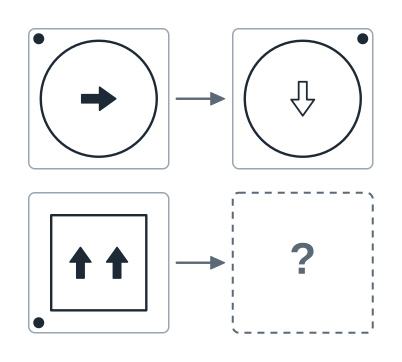
The changes are:
- the arrow turns a quarter turn clockwise (right to down);
- solid becomes outlined;
- the dot moves one corner clockwise.
The shape and the count don't change.
Bottom row: a square with two solid arrows pointing up and a dot in the lower-left corner. Apply the same changes: the arrows turn to point right, become outlined, and the dot moves from lower-left to upper-left. It stays a square with two arrows.
Worked example: Picture Progression
In a 3 × 3 grid, every picture has solid arrows pointing up.
- Across each row, the shape goes triangle, square, pentagon.
- Down each column, the count goes one, two, three arrows.
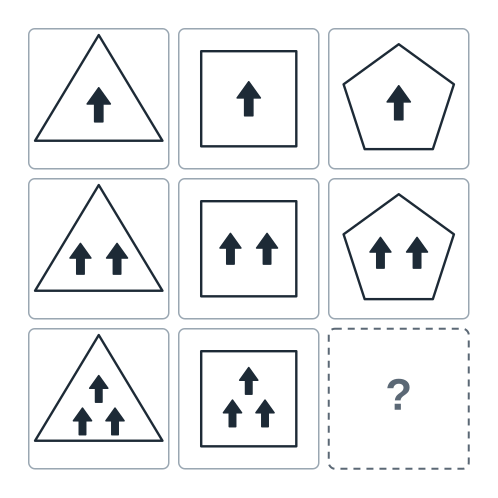
The missing bottom-right picture is in the third column and the third row, so it's a pentagon with three solid arrows pointing up. A pentagon with two arrows fits the row rule but not the column rule, so it's wrong.
Tips
- Turns: a quarter turn is 90°. Three quarter turns clockwise looks the same as one quarter turn counterclockwise.
- Cycles: features like fill often repeat in a cycle (solid, hatched, outlined, then solid again). Apply the same step from the last picture.
- Use elimination. If you can't see a rule, rule out choices that break the rules you can see.
- Keep to 30 seconds. If a puzzle won't come, choose your best answer, flag it, and come back at the end. A wrong answer costs nothing, so never leave one blank.
Practice
The free EEI POSS practice test ends with one puzzle of each kind. Each of our 20 full EEI POSS practice tests has 20 timed Figural Reasoning puzzles, with every answer explained feature by feature. For the whole test, see how to prepare for the EEI POSS.
Watch the video lessons
- POSS Figural Reasoning Picture Series: 5 Timed Questions on ExamVanta's YouTube channel
- POSS Figural Reasoning Picture Comparison: 5 Timed Puzzles on ExamVanta's YouTube channel
- POSS Figural Reasoning Picture Progression: 5 Timed Grids on ExamVanta's YouTube channel
Free to share: you may copy and share this guide unchanged, for non-commercial purposes such as teaching and study, if you credit ExamVanta and link to this page. It's licensed under CC BY-NC-ND 4.0. Material from other sources quoted or shown in it, such as official text or chart excerpts, keeps its own terms.
More EEI POSS guides
- How to Prepare for the EEI POSS Test: A Study Plan
A three-week plan for the EEI POSS: check which battery you'll take, learn what each test asks, use timed practice tests, review your mistakes and pace yourself.
- EEI POSS Mathematical Usage: Short-Math Tips and Practice
How to work the 18-question, 7-minute EEI POSS Mathematical Usage test: using the formulas given at the start, checking units, and when to choose N, with worked examples.
- EEI POSS Mechanical Concepts: Principles and Practice
The principles behind EEI POSS Mechanical Concepts questions, from valves, pipes and tanks to gears, belts, levers, pulleys, heat and circuits, with worked examples.
- EEI POSS Passing Score, Index Score and Test Day
How the EEI POSS index score from 0 to 15 works, why no pass mark is published, how long the test takes, calculator rules, retake waits and what to bring.
- EEI POSS Reading Comprehension: Tips and Practice
How to answer EEI POSS Reading Comprehension questions: reading operator training and safety manuals and answering from the passage, with a worked example.
- EEI POSS/MASS Test: The Combined Power Plant Battery
What the EEI POSS/MASS combined test covers, how the MASS differs from the POSS, short-math and long-math batteries, timing, and what our practice includes.