EEI POSS Mechanical Concepts
The principles behind EEI POSS Mechanical Concepts questions, from valves, pipes and tanks to gears, belts, levers, pulleys, heat and circuits, with worked examples.
Practicing for the EEI POSS? Take the free practice test: 12 questions, no account needed.
The POSS Mechanical Concepts test shows a picture of a mechanical situation and asks what happens: which way a gear turns, which valve isolates a line, where the pressure is greater. EEI's brochure describes 44 multiple-choice questions in 20 minutes, each with three possible answers. That's about 27 seconds a question.
Start with the picture. Our practice questions print their numbers and show their arrangement in the figure, and the words only say what's being asked. Two questions can have the same wording and different answers, because what's drawn is different.
You can't work out the physics from scratch in 27 seconds. The good news is that the same few principles come up again and again. Learn them until you recognize them on sight, and most questions take a few seconds.
Valves, pipes and pumps
- Trace the path. Water reaches a place only if every valve along the way is open. One shut valve stops its whole line, and a check valve only passes flow in the direction it's drawn.
- To take a part out of service, shut the valves either side of it. A bypass, if there is one, keeps flow moving around it.
- Pressure falls along a flowing line, in the direction of flow, and a clogged strainer shows a bigger drop across it.
- Pumps in series add pressure; pumps in parallel add flow.
- Water pools at low points and air gathers at high points, so that's where drains and vents go.
- Follow the linkage. A lever or bell crank can reverse a motion, so check which side of the pivot each rod is on before deciding what a float, governor or damper does.
Gears, belts and chains
- Each external gear mesh reverses the direction. If gear A turns clockwise, a gear meshed with it turns counterclockwise, and a third gear in the row turns clockwise again. Count the meshes: odd reverses, even keeps the direction.
- Speed goes inversely with size. Teeth × rpm is the same for meshed gears. A 15-tooth gear at 120 rpm drives a 45-tooth gear at 120 × 15 ÷ 45 = 40 rpm. The bigger gear turns more slowly but with more turning force.
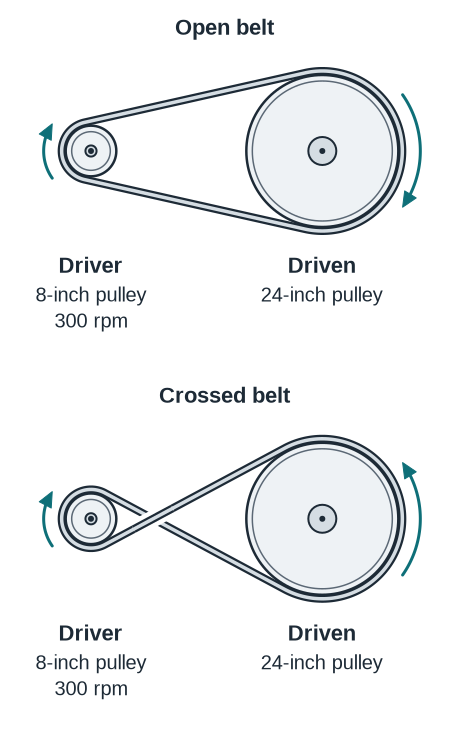
- An open belt keeps the direction; a crossed belt reverses it. Pulley speed follows diameter the same way: an 8-inch pulley at 300 rpm drives a 24-inch pulley at 300 × 8 ÷ 24 = 100 rpm.
- A chain turns both sprockets the same way, like an open belt.
- Parts keyed to one shaft turn together, at the same rpm, whatever their size. A bigger pulley on that shaft moves its rim faster, because the rim travels farther each turn.
Levers, wrenches and balance
- Turning effect = force × distance from the pivot. A beam balances when the turning effects on each side are equal. A 40 N load 3 ft left of the pivot balances 60 N placed 2 ft to the right, because 40 × 3 = 60 × 2.
- If two equal forces act at different distances, the beam turns toward the side with the longer distance.
- A longer wrench handle needs less force for the same turning effect, and pushing at right angles to the handle works best.
- To lift a load level, attach the hook directly above its center of gravity.
Pulleys and hoists
- A single fixed pulley only changes direction. The pull equals the load.
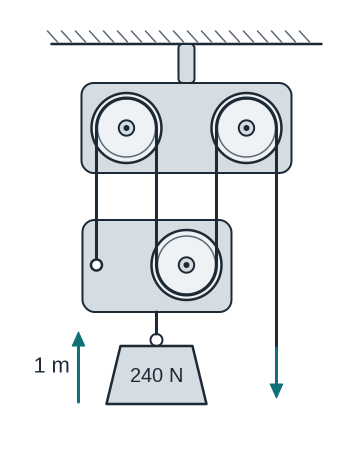
- In an ideal hoist, pull = load ÷ number of supporting strands. Count the rope strands holding up the moving block. Three strands holding a 240 N load need a pull of 240 ÷ 3 = 80 N.
- You pay in rope. With three strands, raising the load 1 m means pulling 3 m of rope.
Hydraulics and pressure
- Pressure is the same throughout a closed hydraulic system. A 30 lb push on a 2 in² piston makes 30 ÷ 2 = 15 psi. On a 10 in² piston, that pressure gives 15 × 10 = 150 lb.
- Force gained is travel lost. In the same system, if the small piston moves 5 in, the large one moves 5 × 2 ÷ 10 = 1 in.
- Pressure = force ÷ area. The same weight on a smaller base presses harder on the ground.
Liquids in tanks and pipes
- Pressure in a still liquid depends on depth below the surface. Deeper means more pressure. Two points at the same depth have equal pressure, however wide or oddly shaped the tank.
- A denser liquid gives more pressure at the same depth.
- Connected open vessels settle at the same surface level.
- Flow in equals flow out. If 30 L/min enters a pipe that splits in two, and branch A carries 12 L/min, branch B carries 18 L/min. Where a pipe narrows, the liquid speeds up.
- A closed valve stops flow in its own branch only. Valves in series: one closed valve stops the whole line.
- A floating object displaces its own weight of liquid. Load a float more and it sinks deeper, displacing more water. A fully submerged object feels a greater buoyant force in a denser liquid.
Springs, wheels and stability
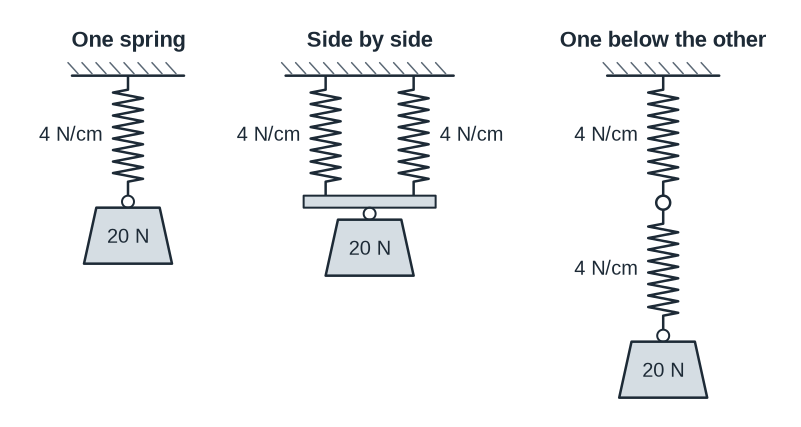
- Spring stretch = force ÷ stiffness. A 4 N/cm spring holding 20 N stretches 20 ÷ 4 = 5 cm. Two such springs side by side share the load and stretch 2.5 cm each. Two hung one below the other each carry the full 20 N, so together they stretch 10 cm.
- A wheel rolls one circumference per turn. A wheel 0.5 m across travels about 3.14 × 0.5 = 1.57 m per turn.
- The point touching the ground is momentarily at rest. The top of a rolling wheel moves twice as fast as its center.
- A wider base or a lower center of gravity makes an object harder to tip.
Heat
- Metals expand when heated, and a hole in a heated plate or ring gets bigger too. A longer rod expands more than a shorter one of the same metal.
- Heat flows from hot to cold. A short, thick metal path conducts faster than a long, thin one; insulation slows it.
- Heating a sealed gas raises its pressure.
Simple circuits
- A lamp lights only in a complete loop. One open switch in a series loop stops everything.
- In series, one failed lamp puts the others out. In parallel, the other branches stay lit.
- Volts = amps × ohms. A 10 Ω heater on a 120 V supply draws 120 ÷ 10 = 12 A.
- Cells in series, + to −, add their voltages. Two 1.5 V cells give 3 V.
How to work fast
- Name the principle before you look at the answers: "two meshes, same direction" or "three strands, a third of the load".
- Use only what the picture and the question give you. Questions assume ideal parts (no friction, weightless ropes) unless they say otherwise.
- Don't count on habits: not the biggest number, not the middle item, and not "equal" as a trick answer. It's right when the picture makes it right.
- If a question needs a calculation, it's usually one step. If you find yourself doing three, re-read the question.
- Don't stall. Choose your best answer, flag it, and come back at the end. A wrong answer costs nothing, so never leave one blank.
Practice
The free EEI POSS practice test includes three Mechanical Concepts questions. Each of our 20 full EEI POSS practice tests has 44 timed Mechanical Concepts questions, each with its own figure and a worked explanation. For the whole test, see how to prepare for the EEI POSS.
Watch the video lessons
- EEI POSS Mechanical Concepts Practice: 8 Timed Gear Questions on ExamVanta's YouTube channel
- EEI POSS Mechanical Concepts: 8 Pulley Practice Questions on ExamVanta's YouTube channel
Free to share: you may copy and share this guide unchanged, for non-commercial purposes such as teaching and study, if you credit ExamVanta and link to this page. It's licensed under CC BY-NC-ND 4.0. Material from other sources quoted or shown in it, such as official text or chart excerpts, keeps its own terms.
More EEI POSS guides
- How to Prepare for the EEI POSS Test: A Study Plan
A three-week plan for the EEI POSS: check which battery you'll take, learn what each test asks, use timed practice tests, review your mistakes and pace yourself.
- EEI POSS Figural Reasoning: Series, Comparison, Progression
How to solve EEI POSS Figural Reasoning puzzles: Picture Series, Picture Comparison and Picture Progression, with a step-by-step method and worked examples.
- EEI POSS Mathematical Usage: Short-Math Tips and Practice
How to work the 18-question, 7-minute EEI POSS Mathematical Usage test: using the formulas given at the start, checking units, and when to choose N, with worked examples.
- EEI POSS Passing Score, Index Score and Test Day
How the EEI POSS index score from 0 to 15 works, why no pass mark is published, how long the test takes, calculator rules, retake waits and what to bring.
- EEI POSS Reading Comprehension: Tips and Practice
How to answer EEI POSS Reading Comprehension questions: reading operator training and safety manuals and answering from the passage, with a worked example.
- EEI POSS/MASS Test: The Combined Power Plant Battery
What the EEI POSS/MASS combined test covers, how the MASS differs from the POSS, short-math and long-math batteries, timing, and what our practice includes.