MultiCrafTest Mechanical Maintenance
The mechanical side of the Ramsay MultiCrafTest: hydraulics and pneumatics, welding and rigging, power transmission and pumps, with formulas and worked examples.
Practicing for the Ramsay MultiCrafTest? Take the free practice test: 14 questions, no account needed.
Four of the seven MultiCrafTest craft areas are mechanical: hydraulics and pneumatics; welding and rigging; power transmission and mechanical maintenance; and pumps, piping and combustion. This guide covers the calculations that come up again and again, and the troubleshooting habits that win the rest. Every example is original.
Hydraulics and pneumatics
Force from pressure. Force = pressure × area. A cylinder with 4 in² of piston area at 650 psi pushes 650 × 4 = 2,600 lbf.
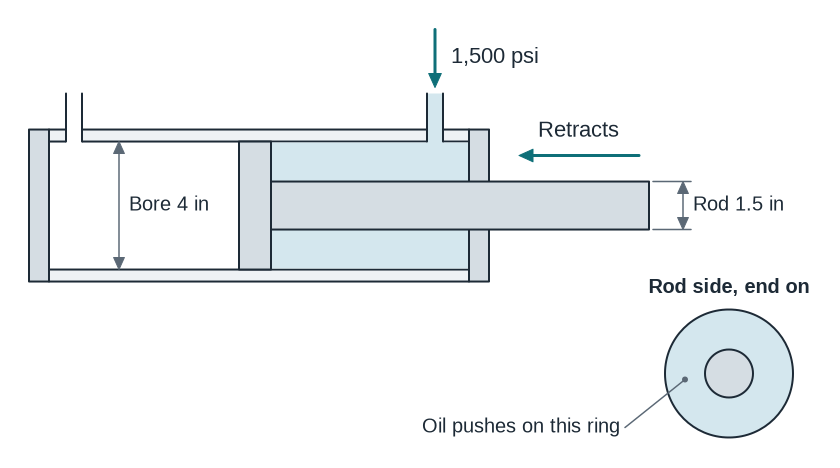
Retracting force. On the rod side, the rod takes up some of the area. A cylinder with a 4-in bore and a 1.5-in rod at 1,500 psi has an annular area of 0.785 × (4² − 1.5²) = 0.785 × 13.75 ≈ 10.8 in², so it pulls about 1,500 × 10.8 ≈ 16,200 lbf. It always retracts with less force than it extends at the same pressure.
Cylinder speed from flow. Speed = flow ÷ area. One US gallon is 231 in³, so 9 gal/min into a 6 in² piston is 9 × 231 ÷ 60 ÷ 6 ≈ 5.8 in/s.
Troubleshooting.
- A system running hot with high return flow over the relief valve usually means oil is dumping over relief instead of doing work.
- A load that runs away when lowered needs a counterbalance valve, not more flow.
- A filter indicator that never moves isn't proof of a clean filter; check that it works.
Welding and rigging
Sling tension rises as the angle flattens. For two equal legs at angle θ above horizontal, each leg carries: tension = load ÷ (2 × sin θ).
| Leg angle | Tension in each leg, 2,000 lbf load |
|---|---|
| 60° | 2,000 ÷ (2 × 0.866) ≈ 1,155 lbf |
| 45° | 2,000 ÷ (2 × 0.707) ≈ 1,414 lbf |
| 30° | 2,000 ÷ (2 × 0.5) = 2,000 lbf |
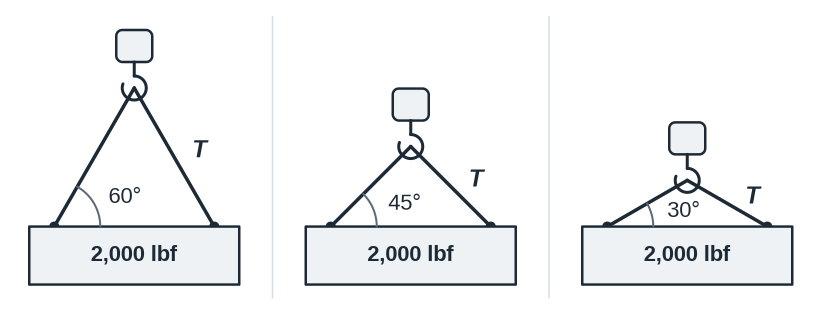
At 30°, each leg carries the whole weight. Below 30°, it carries more than the load itself.
Load share. A load hung evenly from four vertical legs puts a quarter of its weight on each.
Welding.
- Porosity usually points to a shielding or contamination problem: gas coverage, draughts, moisture or dirty base metal.
- Undercut usually points to too much current, too long an arc, or the wrong travel speed or angle.
- Low-hydrogen electrodes must be kept dry, typically in a rod oven once the can is opened.
- Oxyfuel outfits need flashback arrestors and correct lighting and shut-down sequences.
Power transmission and mechanical maintenance
Belt speed. Driven speed = driver speed × driver diameter ÷ driven diameter. A 4-in pulley at 1,750 rpm drives a 7-in pulley at 1,750 × 4 ÷ 7 = 1,000 rpm.
Gear torque. Speed goes down by the tooth ratio, and torque goes up by the same ratio, ignoring losses. A 15-tooth driver delivering 40 lbf-ft to a 45-tooth gear gives 40 × 45 ÷ 15 = 120 lbf-ft, at a third of the speed.
Levers and torque. Force × distance balances on each side of the pivot: 50 lbf at 3 ft balances 50 × 3 ÷ 2 = 75 lbf at 2 ft. A wrench torque is force × handle length.
Troubleshooting.
- A bearing that runs hot straight after heavy greasing is usually over-greased: the grease churns.
- A chain riding high on the sprocket teeth after tensioning is usually elongated from wear.
- Vibration at once per revolution often points to imbalance or runout.
Pumps, piping and combustion
Affinity laws. For the same centrifugal pump at a new speed:
- flow changes with speed;
- head changes with speed squared;
- power changes with speed cubed.
Halve the speed from 1,800 to 900 rpm and a pump giving 120 gal/min, 80 ft of head and 16 kW gives 60 gal/min, 20 ft and 2 kW.
Discharge pressure. Discharge = suction pressure + the pressure the pump adds.
Troubleshooting.
- Gravel-like noise and falling flow at the pump suggest cavitation: not enough net positive suction head (NPSH), often from a clogged strainer or a starved suction.
- Banging when a valve closes fast is water hammer.
- A steam trap blowing live steam into the return has failed open.
How to work fast
- Name the formula first, then put the numbers in.
- Check that the answer makes sense: a bigger driven pulley must turn slower, and a flatter sling must pull harder.
- In troubleshooting questions, choose the cause that explains every symptom given.
Practice
The free MultiCrafTest practice test has two questions from each craft area. Each of our 20 full practice tests mixes 60 questions across all seven areas, with a worked explanation for every one. For the electrical areas, see the electrical maintenance guide.
Free to share: you may copy and share this guide unchanged, for non-commercial purposes such as teaching and study, if you credit ExamVanta and link to this page. It's licensed under CC BY-NC-ND 4.0. Material from other sources quoted or shown in it, such as official text or chart excerpts, keeps its own terms.
More Ramsay MultiCrafTest guides
- How to Prepare for the Ramsay MultiCrafTest: A Study Plan
A practical plan for the Ramsay MultiCrafTest: what the seven craft areas cover, how to find your weakest areas, which formulas to know, and how to pace 60 questions.
- MultiCrafTest AC/DC Theory: Three-Phase Power and Safety
AC/DC theory and electrical maintenance for the Ramsay MultiCrafTest: Ohm's law, three-phase power, transformers, voltage drop, grounding, insulation tests and safe work.
- MultiCrafTest Electrical Maintenance: Formulas, Ladder Logic
The electrical side of the Ramsay MultiCrafTest: AC/DC theory, motors and controls, ladder diagrams and PLC signals, with formulas and worked examples.
- MultiCrafTest Hydraulics and Pneumatics: Worked Examples
Hydraulics and pneumatics for the Ramsay MultiCrafTest: force, speed, horsepower and heat, valves, air use and troubleshooting, with worked examples you can check.
- MultiCrafTest Motors and Controls: Starters, VFDs, Prints
Motors, controls and print reading for the Ramsay MultiCrafTest: motor speed and slip, starters, seal-in, reversing, jog, VFDs and ladder prints, with worked examples.
- MultiCrafTest PLCs, Electronics and Test Instruments Guide
PLCs, electronics and test instruments for the Ramsay MultiCrafTest: PLC scan and I/O, 4–20 mA scaling, sensors, safe meter use and logic gates, with worked examples.
- MultiCrafTest Power Transmission: Belts, Gears, Bearings
Power transmission and mechanical maintenance for the Ramsay MultiCrafTest: drive ratios, torque, chains, bearing life, lubrication, alignment and bolting, with examples.
- MultiCrafTest Pumps, Piping and Combustion: Worked Examples
Pumps, piping and combustion for the Ramsay MultiCrafTest: head and pressure, pump power, affinity laws, NPSH and cavitation, water hammer, steam traps and burners.
- MultiCrafTest Welding and Rigging: Sling Angles and Welds
Welding and rigging for the Ramsay MultiCrafTest: sling tension, load share, hitch capacity, electrodes, weld defects, heat input and hot work, with worked examples.
- Ramsay MecTest vs MultiCrafTest: Which Test Is Yours?
Ramsay's maintenance tests compared: MultiCrafTest, MecTest, Maintenance Troubleshooter, MultiCraft Aptitude Test and more, by items, level and content.
- Ramsay MultiCrafTest Scores: Norms, Percentiles, Cut Scores
What a Ramsay MultiCrafTest score means: Ramsay's published norms, a score of 40 of 60 against them, percentiles, employer cut scores and retesting.